
Home > Guides > Nixodine-S (6-MN)
What Is Nixodine-S (6-MN)? 6-Methylnicotine vs. Nicotine, Testing & Safety
A practical guide to 6-methylnicotine (6-MN) | By Shane Johnson, Founder
Expert Review & Compliance Update: October 16, 2026
Nixodine-S is a form of 6-methylnicotine, also called 6-MN. This guide explains what it is, how Nixodine-S compares with traditional nicotine, whether standard nicotine tests may detect it, and what current research says about safety.
What Is Nixodine-S? Quick Summary
Nixodine-S (6-Methylnicotine) is a 100% lab-synthesized nicotine analogue that contains ZERO actual nicotine. It is engineered to activate the exact same nicotinic acetylcholine receptors (nAChRs) in the brain as traditional nicotine, providing identical satisfaction. Because it is chemically distinct, it does not metabolize into cotinine and will not show up on standard nicotine drug tests.
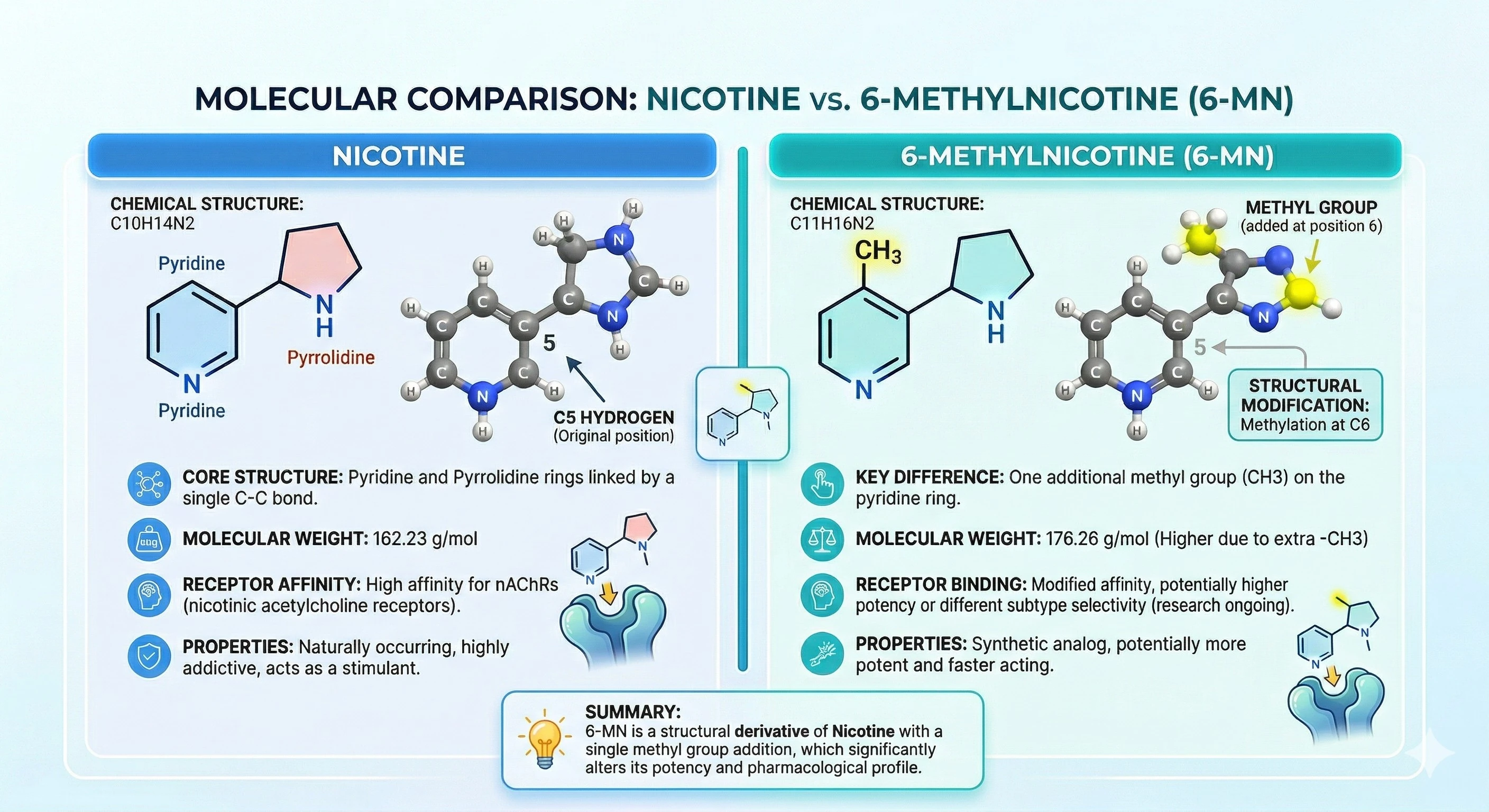
Infographic: How Nixodine-S achieves molecular mimicry without tobacco-derived metabolites.
What Is Nixodine-S? Quick Answers About 6-Methylnicotine
What is Nixodine-S?
Nixodine-S is a synthetic nicotine analogue commonly referred to as 6-methylnicotine or 6-MN.
Is 6-methylnicotine the same as nicotine?
No. It is chemically similar to nicotine, but it is not traditional tobacco-derived nicotine.
Does Nixodine-S show up on nicotine tests?
Standard nicotine tests usually look for cotinine, a nicotine metabolite. 6-methylnicotine is different, so standard cotinine tests may not detect it.
Is Nixodine-S addictive?
It may be addictive because it interacts with nicotine receptors. More research is still needed.
Why are vape companies using 6-MN?
Some companies use 6-MN because it can provide a nicotine-like experience while being chemically distinct from traditional nicotine.
Nixodine-S vs. Nicotine: Why 6-Methylnicotine Feels Similar
The core science of Nixodine-S lies in its molecular mimicry. Traditional nicotine and synthetic nicotine both bind to specific receptors in your brain to provide a “hit.” Nixodine-S (6-MN) is a different molecule that “fools” the brain by activating these same receptors.
- Nicotine and Cotinine Testing: Standard screenings look for cotinine. Nixodine-S follows a different metabolic pathway and does not trigger a positive result for nicotine use.
- Nationwide Availability: As a non-tobacco analogue, it falls outside the scope of tobacco-specific restrictions, ensuring 100% shipping availability to New York and California.
Is Nixodine-S Safe? What Current Research Says
Transparency is our policy. 6-Methylnicotine has been documented in scientific literature for over 60 years. While it activates the same pathways as traditional nicotine and is considered addictive, the safety profile of Nixodine-S is defined by its pharmaceutical-grade origin:
USP-Grade Purity: Nixodine-S is 100% lab-controlled, eliminating heavy metals, pesticides, and nitrosamines common in tobacco-derived extractions.
Superior Stability: 6-MN is molecularly sturdier than tobacco nicotine. It won’t oxidize or “brown” your juice as quickly, keeping flavor density at maximum saturation.
| Comparison | Tobacco Nicotine | Nixodine-S (6-MN) |
|---|---|---|
| Nicotine Content | High | ZERO (0.00%) |
| Drug Test Result | Positive (Cotinine) | NEGATIVE |
| Origin | Tobacco Extraction | 100% Lab-Synthesized |
Ready to Try Nixodine-S?
Experience zero traditional nicotine, negative cotinine screening results, and superior flavor stability. Ships directly to all 50 states!
- [1] Aceto, M. D., et al. (1986). “Pharmacological studies of 6-methylnicotine.”
- [2] Romano, C., et al. (1981). “Nicotine receptor binding affinity: Analysis of 6-methylnicotine.”
- [3] Federal Institute for Risk Assessment (BfR 2026). “Opinion No. 011/2026.”

Shane Johnson Founder & Master Mixer
Shane Johnson founded Fuzion Vapor in 2012 and has worked in the vape industry since then, developing extensive experience with nicotine analogues and flavor formulation.